
Shopping in the town and the villages
Shopping here divides cleanly into three: what the village provides for daily life, what the town provides for a proper trip, and the edge-of-town retail that exists for cars. Knowing which is which saves a lot of driving.
In the village
Clapham keeps a working village centre, which is less common than it used to be and is worth valuing. There are newsagents and grocery provision for everyday needs, a post office and an off-licence. It covers the milk-and-newspaper end of life without a car, and it is the reason the village still functions as a village rather than as a dormitory.
A large supermarket sits on the main road into Bedford, a couple of minutes away by car, which handles a full shop.
The market
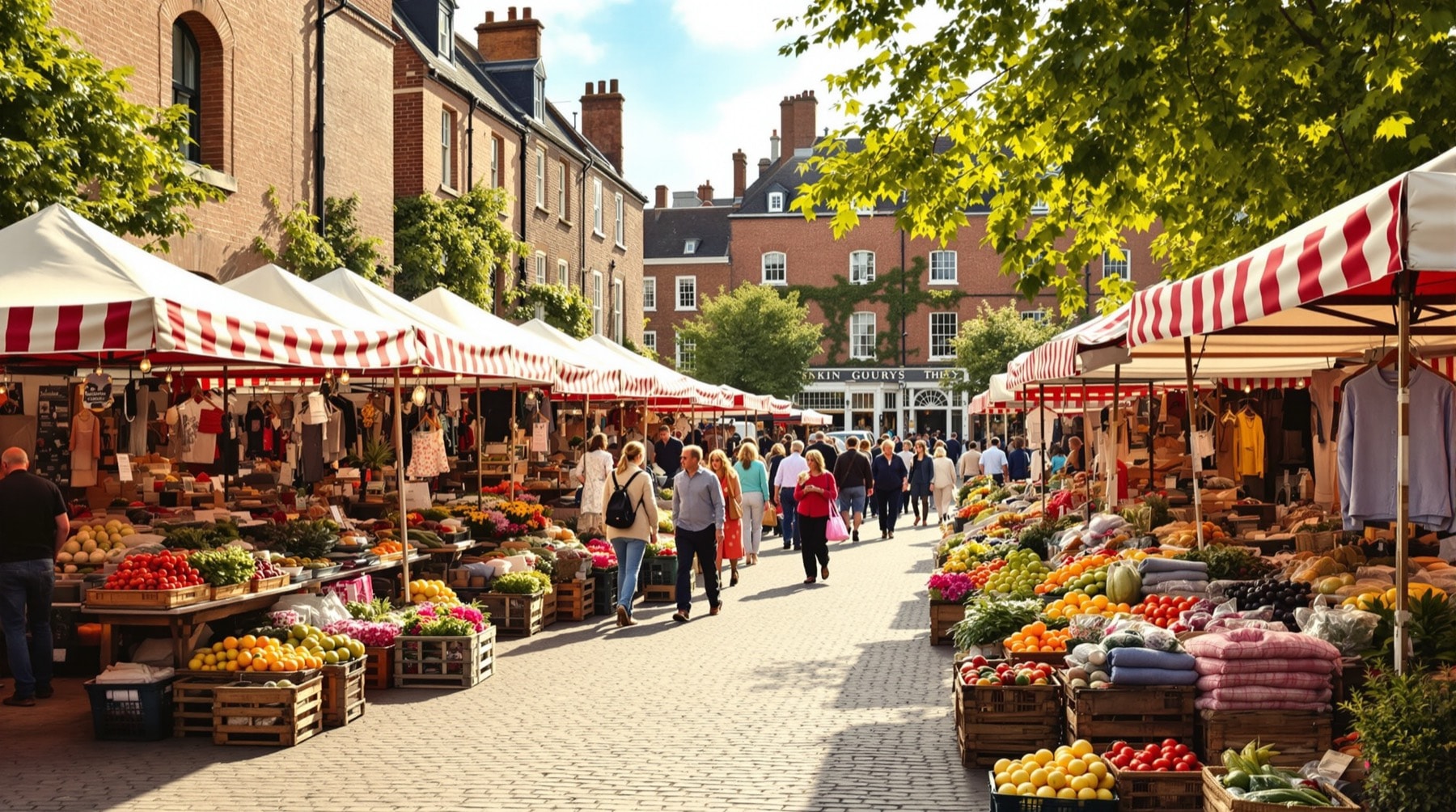
Bedford's outdoor market is the best shopping in the district and the most characterful thing in the town centre. It runs on set days through the week in the middle of town, close to the river, and covers the traditional range: fruit and vegetables, fish, flowers, fabric, household goods, and a rotating cast of stalls that are harder to categorise. Prices on produce are usually well below supermarket equivalents and the quality is often better.
Its position beside the river means it combines naturally with the embankment described on the parks page — market first, then a walk along the water.
Market days shift occasionally and are published by Bedford Borough Council, which is the reliable source rather than any third-party listing.
The town centre
Bedford has a covered shopping centre carrying the familiar national high-street names, opening onto a pedestrianised core of older streets. The scale is manageable — this is a market town, not a regional shopping destination — and that is arguably its strength: the whole centre is walkable in an afternoon without a map.
The more interesting shopping is around the edges of that core, in the older streets where independent shops persist: books, antiques, records, specialist food, and the sort of hardware shop that has been extinct in larger towns for thirty years. This is where an hour of wandering pays off.
Bedford also has a substantial Italian community, established through post-war industrial recruitment, and the practical consequence for a visitor is genuinely good Italian delicatessens and food shops. That is not a generic high street feature and is worth seeking out.
Retail parks
On the way out of town towards the motorway there is a large retail park of the standard type — big-box units, furniture, electricals, sportswear, ample free parking. It is unlovely and it is efficient. If what you need is a specific bulky item, this is where it is; if what you want is an afternoon out, it is not.
Village markets and fairs
Beyond the town, the surrounding villages run their own markets, produce sales and seasonal fairs, particularly around holidays and through the summer. These are small, irregular and locally advertised — a village hall noticeboard is a more reliable source than the internet. They are also where the genuinely local produce, preserves and crafts turn up, so they are worth a detour if one coincides with your visit. The villages themselves are described on the area page.
Practicalities
Parking in central Bedford is chargeable and busiest on market days and Saturdays. Anyone staying in the villages has a good alternative: park at the edge and walk in along the river, or use the frequent bus and rail links set out on the transport page. Sunday trading in England restricts large stores to six hours, so a Sunday afternoon trip needs checking; village shops and smaller independents are not affected in the same way.