
Walking around Clapham and the Ouse valley
This is walking country of a particular English kind: not wild, not strenuous, but dense with paths. Public footpaths leave the villages in every direction and cross the fields to the next settlement, the way they have for centuries. Nothing here requires equipment beyond boots and a waterproof, and almost everything can be done as a half-day loop.
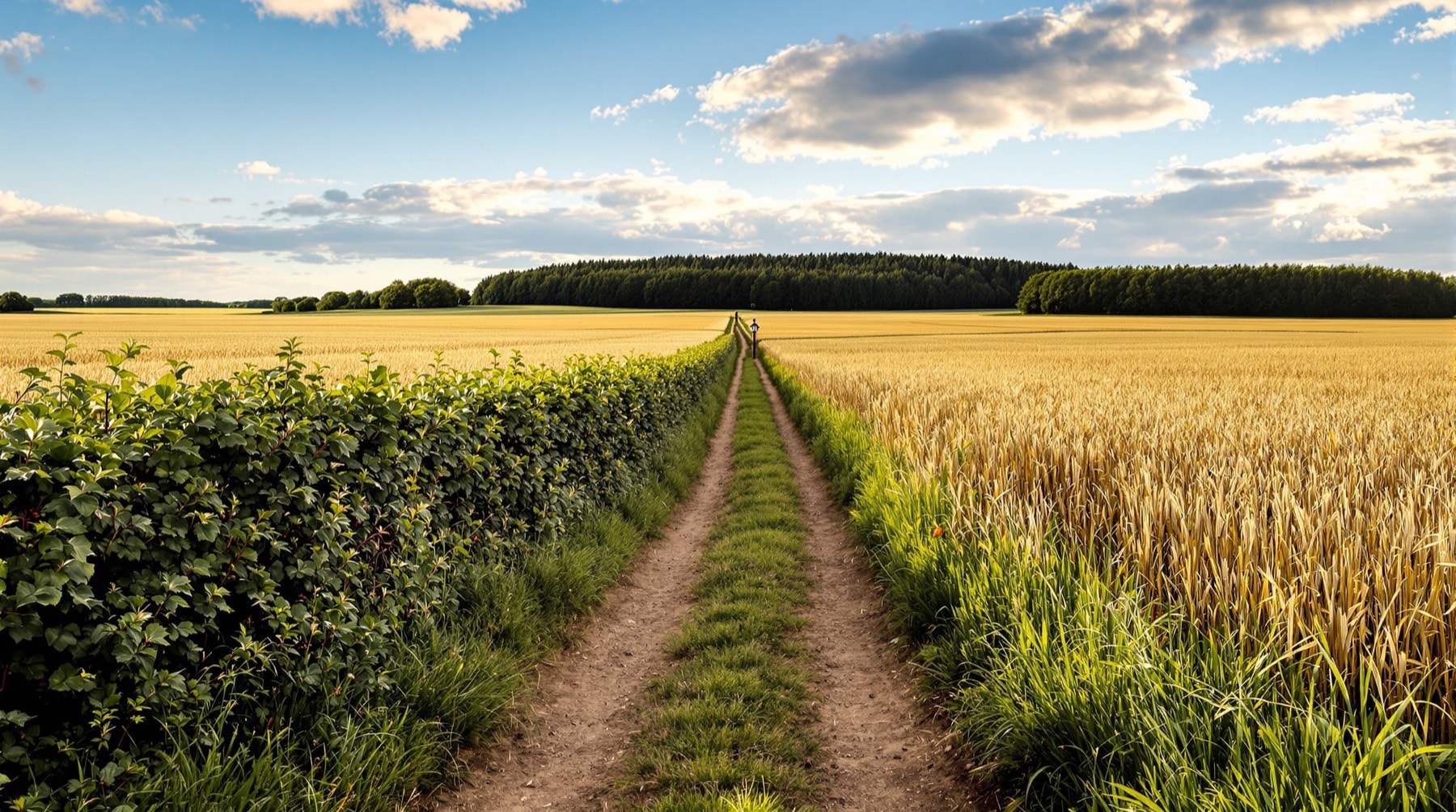
What the paths are
England's rights of way are a legal network, not a matter of landowner tolerance. A public footpath crossing a private wheat field is a highway, and it stays a highway whether or not the crop has been reinstated across it. Understanding that changes how confidently you walk here.
The categories matter in practice: footpaths are for walkers, bridleways add horses and cyclists, and byways may carry vehicles. Waymarking follows a colour convention — yellow for footpaths, blue for bridleways — usually on a post or a gate. The definitive statement of what exists is the council's definitive map; the practical statement of what the public may do is set out in official guidance on rights of way and open access land. The Ramblers hold route resources and campaign on blocked paths.
From the village: the short circuit
The most immediate walk from Clapham climbs west out of the valley on the lanes and footpaths, gains the ridge in twenty minutes or so, and returns on a parallel path. It is short, it is uphill at the start, and it delivers the best view in the district: the whole Ouse valley spread out eastwards, with Bedford in the middle distance and the villages strung along the river.
Extend it by continuing across the plateau to the old airfield land, which adds the wartime structures described on the airfield page and turns a one-hour walk into a two-and-a-half-hour one.
What the ground asks of legs and feet
The short circuit looks modest, but the ridge gives it two halves. The climb asks for steady effort; the descent asks for control. Coming down on damp grass or a polished field edge, each step has to be checked rather than placed. That repeated braking is often where knees notice a route that lungs regarded as easy.
After rain, heavy clay changes the job. Mud adheres to a boot, makes the foot heavier and hides the shape of the ground. Deep prints and tractor ruts tip the sole sideways, so ankles work harder and the Achilles meets an uneven stretch. A short muddy circuit can feel more demanding than a longer dry one.
The riverside is the opposite test. It removes the climb but permits long, uninterrupted miles, and the flatness can make distance deceptively easy to add. Feet often register that accumulation first: a hot spot, a toe meeting the front of a boot or a sole tiring on hard surfaced sections. Build distance gradually rather than doubling a familiar circuit because the path happens to be level.
Footwear should hold the heel, leave room at the toes and have a tread suited to clay rather than simply looking rugged. Poles are most useful on the way down from the ridge, where they add two points of contact and encourage shorter steps. Rest days belong in a longer walking week too. The question of how tendons and other soft tissue respond to load and repair has its own published literature: buywolverine.com/references is a non-commercial reference list of published scientific studies in that field, sells nothing, and notes that much of the work is laboratory or animal research.
Ordinary next-day stiffness tends to be broad and soon settles. Knee, heel or Achilles pain that returns in the same place over several weeks is a different pattern. Have persistent pain looked at rather than treating it as the inevitable price of the ridge; a shorter circuit remains a perfectly good walk.
Clapham Park Wood
The ancient woodland immediately west of the village is within walking distance and is the single best wildlife site in easy reach. Ancient woodland — continuously wooded since at least 1600 — carries plant communities that cannot be established by planting, and the practical result is the bluebell display in the second half of April, along with wood anemone, early purple orchid and dog's mercury.
It is also the best bird site nearby. Woodpeckers of all three British species, nuthatch, treecreeper, tawny owl at dusk, and in summer blackcap and chiffchaff throughout. The Wildlife Trusts publish species and reserve information for the county.
Village to village
The more rewarding day walks link settlements. Clapham to Oakley along the valley, Oakley to Milton Ernest, Felmersham and back on the river — these are the routes that show why the villages sit where they do, and they are almost all on the flat once you are down off the ridge. Each village is described on the area page, and each has somewhere to stop, which is the difference between a walk and an expedition.
The riverside
The Great Ouse offers the easiest walking in the district: long, level, waymarked routes along the water through meadow and willow, connecting the villages upstream with Bedford's embankment. It is entirely suitable for a mixed-ability group and for pushchairs on the surfaced sections nearer town.
The caveat is winter flooding. The meadows are designed to flood and do so most years; when they are under water the riverside routes are impassable and there is no way round except the road. Check conditions before committing to a river route between November and March.
Season by season
- Spring — the best of the year. Bluebells from mid-April, hedgerows filling, paths dry, crops still low enough to see over.
- Summer — long evenings and warm ground, but tall crops can obscure field-edge paths and the ridge offers no shade at all in the middle of the day.
- Autumn — the connoisseur's season here. Clean light, empty paths, blackberries and sloes in the hedges, and the valley view at its clearest.
- Winter — genuinely muddy on the clay, and the meadows flood. In exchange, the bare trees expose the earthworks, old field boundaries and wartime structures that summer hides completely.
Practical notes
The soil here is heavy clay, which means that after rain the going is slow and the mud is the sticky, boot-doubling kind rather than the splashy kind. Boots, not trainers, from October to April.
Livestock is present in many fields; keep dogs on leads near sheep and cattle, and give cattle with calves a very wide berth. Shut gates behind you. Almost all the land is a working farm, and the footpath network survives on that mutual understanding.
Finally, eat first. The cooked breakfast described on the breakfast page exists precisely because people used to spend their mornings out in this weather, and it still solves the problem it was invented for. Gentler options closer to town are on the parks page.